

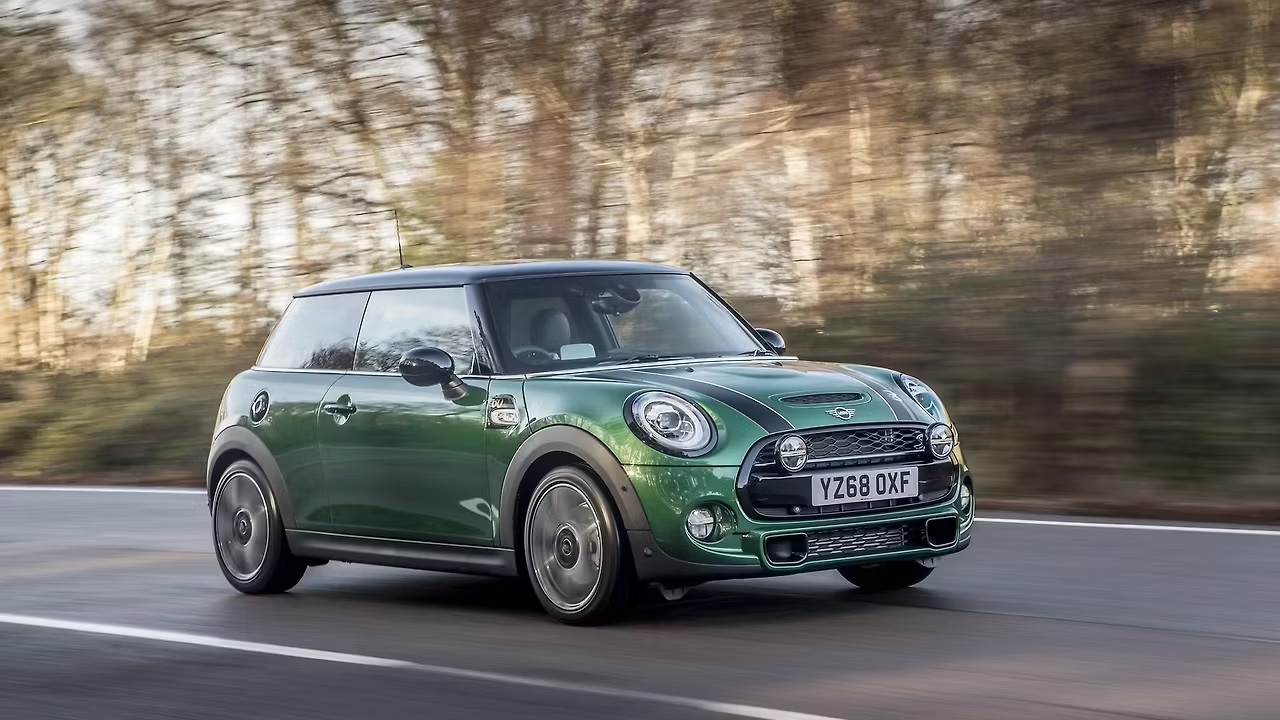
There’s a common misconception that the MINI is just a weekend toy for young women heading to coffee shops. After all, how could a car so irresistibly cute ever stand toe-to-toe with “serious” machines? What could its round headlights and cheerful stance evoke besides affection?
In truth, this is one of the boldest and most accomplished competitors in motorsport history, and for shoppers exploring their options, this guide on which MINI Cooper to buy will be a useful starting point for understanding the lineup.
However, to understand its real identity, we must rewind to the 1950s – an era when fuel shortages ignited a wave of creativity that produced not another dull economy car but a charismatic little rebel.
The Birth of a Legend: Crisis as the Engine of Progress
The story of the MINI did not begin on a racetrack but rather amidst the political turmoil of the global stage. In 1956, the Suez Crisis caused oil pipelines to run dry. Gasoline in Britain was rationed, and the British public began switching en masse from gas-guzzling American behemoths to German “bubble cars” – such as the BMW Isetta – three-wheeled coffins that were both cramped and unsafe.
But Leonard Lord, the head of the British Motor Corporation, detested these “bubbles.” Consequently, he issued a challenge to engineer Alec Issigonis: create a true microcar capable of seating four adults while consuming gasoline by the teaspoonful. At first glance, the task seemed impossible. Yet Issigonis turned conventional engineering wisdom completely on its head.
He established an ironclad rule: 80% of the car’s interior volume must be dedicated to people and only 20% to machinery. To package four occupants into a body just three meters long, the engineer mounted the engine transversely, positioned the gearbox directly beneath it, and adopted a front-wheel-drive layout.
To ensure the wheel arches wouldn’t encroach upon the cabin space, he pushed the wheels out to the very corners of the body. Development took just over two years, and on August 26, 1959, the first MINI rolled out of the factory gates. The world gasped in amazement!
The Cooper Effect: How a “Handbag” Became a Champion
Issigonis referred to his creation as a “housewife’s car,” but designer John Cooper, upon seeing the prototype, was absolutely thrilled. He recognized a predator lurking within this budget-friendly compact. A short wheelbase, wheels pushed to the corners, stiff suspension – it was essentially a go-kart in disguise! Cooper persuaded management to produce a “hot” version featuring a more powerful engine and disc brakes. Thus, the MINI Cooper was born.
Then, in 1964, a sensation occurred: the tiny British car won the legendary Monte Carlo Rally. On the winding mountain roads, it devoured massive V8-powered Ford Falcons and powerful Mercedes machines. It became clear then that, in racing, victory belongs not to brute force but to perfect balance and handling. The Finn Timo Mäkinen and the Swede Paddy Hopkirk repeated this triumph in 1965 and 1967, forever etching the name MINI into the annals of motorsport history.
But the real explosion of popularity took place on the streets of London. In the buttoned-up England of the 1960s, the MINI erased social boundaries; it was driven by everyone from factory workers to lords. Mick Jagger of the Rolling Stones zipped around Soho in his MINI, the Beatles bought one for every member of the band, and the Queen gifted a MINI to Princess Margaret. Mary Quant, inspired by the car’s compact dimensions, invented the mini-skirt. And so, the car became a style icon.
Revival: How BMW Resurrected an Icon
By the 1980s, however, the MINI’s design had become hopelessly outdated. The world had fallen in love with safe, spacious hatchbacks, yet the “old-timer” continued to roll off the assembly line with almost no changes. Still, it remained beloved for its character. The MINI had ceased to be merely a car; it had become a classic.
A major turning point arrived in 1994 when the BMW Group acquired the Rover Group, and, along with it, MINI. The Germans immediately recognized that they held a “sleeping beauty” in their hands – a brand with colossal potential. Yet the task was far from simple: to create a modern, technologically advanced automobile that would still be perceived as a spiritual successor to the 1959 original. On October 4, 2000, the very last “old” MINI rolled off the assembly line, bringing the total production count to 5,387,862 units.
A year later, the world witnessed the debut of the new MINI by BMW. The Bavarians preserved almost every signature element – the round headlights, the wheels pushed out to the corners, and that unmistakable “go-kart” driving feel but added premium quality, leather upholstery, climate control, and powerful turbocharged engines. Thus, for the very first time, a small car ascended to the ranks of premium automobiles.
MINI Today
The brand’s philosophy is built upon three simple pillars: handling, individuality, and design. Every MINI embodies the “go-kart effect.” You feel the road quite literally at your fingertips. The steering is razor-sharp, body roll is virtually non-existent, and the car carves through corners as if running on rails. It is not merely driving – it is pure exhilaration. Moreover, no two MINIs in the world are exactly alike. Millions of possible combinations, encompassing body colors, contrasting roof finishes, and racing stripes, allow every owner to curate their own unique work of art.
The interior serves as a direct link to the brand’s heritage. The massive, circular central instrument cluster pays homage to the very first MINI, in which the speedometer was positioned at the center of the dashboard so it could be easily viewed by both the driver and passenger.
The modern MINI is no longer just a single model but an entire family. At the core of the lineup sits the MINI Hatch (available in 3- and 5-door configurations) – the direct heir to the legend. It is the very quintessence of the brand: a spirited, exhilarating urban go-kart. For those requiring more space, there is the MINI Countryman. This is the brand’s first full-fledged crossover, proving that the signature go-kart handling pairs perfectly with all-wheel drive and increased ground clearance.
At the very pinnacle of the lineup sit the potent John Cooper Works (JCW) variants. These are essentially ready-to-race machines, featuring a retuned suspension, an aggressive exhaust system, and power outputs starting at 228 horsepower. Gradually, the currently trending wave of electrification is weaving its way into the brand’s history.
The MINI Cooper SE delivers that same go-kart experience – only now, it comes without an exhaust pipe. A heavy battery pack embedded in the floor lowers the center of gravity even further, while 218 horsepower and 243 lb-ft of torque catapult the car away from a stop almost instantaneously. It accelerates from zero to 60 mph in 6.7 seconds, with no pauses for gear shifts.
In the big city, the MINI feels right at home. In crowded parking lots, where massive SUVs circle hopelessly in search of a suitable spot, the Mini always manages to find its own little nook. Its agility allows it to change lanes in heavy traffic with surgical precision. Thanks to its short wheelbase and excellent weight distribution, the MINI remains remarkably stable even on snow-covered roads.
Ultimately, the MINI is a car that evokes pure emotion. It may ride a bit stiffly over potholes or demand premium fuel or access to a charging outlet, but it will never be boring. Every single drive becomes a mini-adventure. Perhaps that is why people don’t buy a MINI out of cold calculation. They choose it with their hearts.
